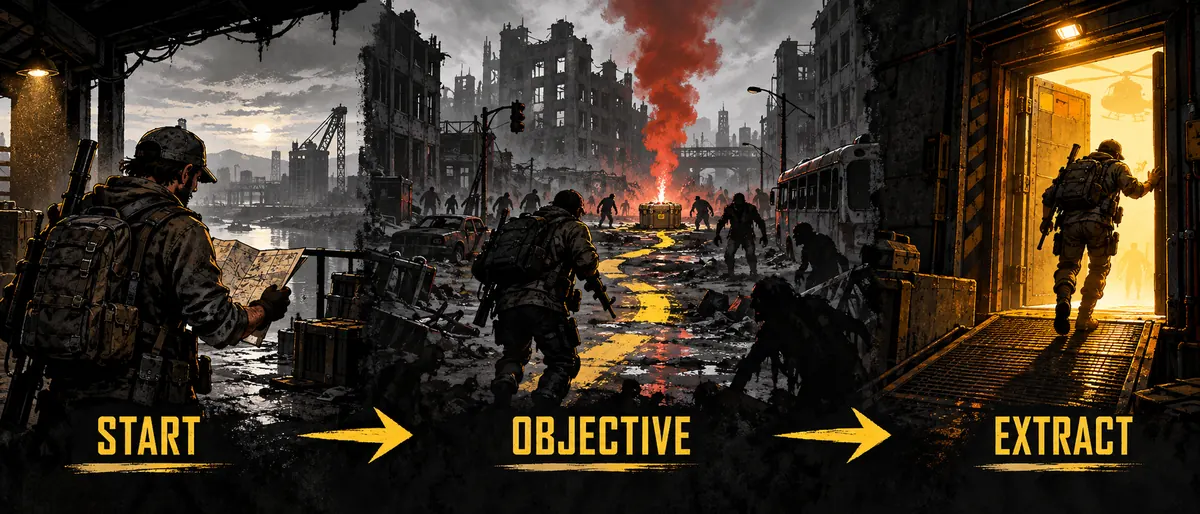
No More Room in Hell 2 missions: what counts?
The word mission is used loosely in player conversations. Sometimes it means the whole Objective session, sometimes a single interaction inside a map, and sometimes the route from the first task to extraction. Those are related, but they are not interchangeable. A useful mission note names the mode, the task chain, the route commitment, and the exit condition. A map page can tell you where a scenario happens; a mission guide explains what the squad is trying to finish and when the cost of continuing becomes larger than the reward.
The official 1.0 release material describes a co-op loop built around objectives, pressure, and extraction. Steam also frames the game around missions, maps, teamwork, and a choice between an early or final extraction. That supports a practical reading of the term, not a claim that every objective has a public, stable name. When a patch changes a room, item, or route, the decision framework can remain useful even if a location note needs an update.
| Mission layer | What the squad decides | What to record |
|---|---|---|
| Mode | Objective route or Survival holdout. | Mode, map, difficulty and patch. |
| Task chain | Which interaction or checkpoint must happen next. | Order, detours and blocked paths. |
| Commitment | When the team spends noise, ammo, stamina or time. | First escalation and fallback route. |
| Exit | Whether to leave early, push for the final extraction, or abandon the run. | Extraction state and resources remaining. |
Objective and Survival missions: different planning problems
Objective is the larger route-driven problem. The team has to read a sequence, protect the player interacting with an object, and keep enough information to get back out. The mission is not finished when the first task turns green; it is finished when the squad can make an informed extraction choice. That is why an objective guide should talk about handoffs, noise, and the last safe room rather than only list a location.
Survival is a different shape. The useful question is how long the team can hold a defensible space and when to rotate before the fallback disappears. It can still contain tasks and decisions, but its pressure is measured by space, waves, supplies and timing. Calling every Survival session a campaign mission creates confusion when players search for mission count or length. Keep the format label beside every observation.
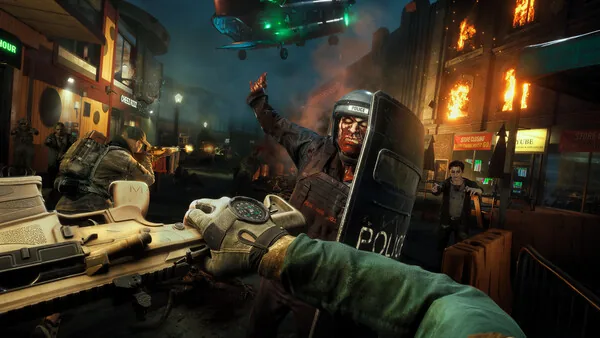
Mission planning table: route, supplies and extraction
Before queuing, decide what the run is trying to preserve. A squad that only plans the first objective can complete the task and still lose the mission at the exit. The table below turns a vague “best mission” search into repeatable choices.
| Pressure | Question before the run | Practical response |
|---|---|---|
| Route commitment | Where does a quick check become a deep push? | Mark one progress route and one return route before spending rare supplies. |
| Noise | Which action can turn a quiet room into a corridor problem? | Let one player interact while another watches the exit and calls movement. |
| Resources | What must remain for the extraction window? | Keep a firearm, throwable or healing option for the part of the mission you cannot repeat cheaply. |
| Team state | Who remembers the route if the squad splits? | Use one route caller and repeat the next checkpoint out loud. |
| Exit | What event makes the final push no longer worth it? | Set a retreat trigger before the team is surrounded. |
Are there solo-friendly missions?
Similarweb shows strong interest in the phrase “are there any solo friendly missions on No More Room in Hell 2,” but the public sources checked do not provide an official solo mission tier list. A safer answer is to describe mission properties. A solo-friendly run has a short information chain, a visible fallback, manageable interaction time, and an exit that does not require three players to cover separate doors at once. That is a planning test, not a permanent label attached to one map.
Solo players should also separate “possible” from “efficient.” A mission can be completable alone while still being a poor choice for experience, credits or learning a new route. Use the solo guide for inventory discipline and the map index for scenario context. If the route demands a long interaction in an exposed room, the correct answer may be to wait, rotate or leave early rather than force a hero play.
For a duo or three-player squad, add coverage instead of assuming the world becomes easier. One responder can interact, one can watch the approach and one can hold the fallback, but those are team advantages. They are not proof that the game automatically reduces enemy numbers when a player joins.

How many missions are there, and how long is a mission?
Search data contains “No More Room in Hell 2 how many missions,” “best missions for XP,” and “mission length,” but the official pages checked on 2026-10-24 do not publish a stable complete number that can be safely copied into a permanent table. The game is version-aware, and community lists can mix modes, maps, objectives and update-era names. The honest answer is therefore a boundary: verify the live build before stating a count, and explain what the count includes.
Mission length is just as variable. A fast run may use a known route and leave at the first safe extraction; a learning run spends time reading rooms, rescuing teammates or testing a detour. Report a range only when the mode, map, party size, difficulty and extraction choice are stated. Do not turn one stream or one lucky run into a universal timer.
A repeatable mission test
If you want to compare missions or answer a new patch question, use a small log rather than a memory-based ranking.
- Lock the context. Record mode, map, difficulty, version, party size, region and date.
- Name the decision. Write the task chain in neutral terms such as “secure the checkpoint, carry the item, return to extraction.” Avoid inventing a canonical name.
- Run a baseline. Note the first contact, first escalation, supply use, teammate state and extraction option.
- Repeat comparable runs. Three runs under the same conditions are more useful than one dramatic success.
- Separate world and team effects. A better result may come from communication, route knowledge or a lucky spawn, not from a hidden mission multiplier.
- Publish the boundary. Add the date, patch and what was not observed. “Not confirmed” is useful information after an update.
What can change after an update?
Mission names, objective order, item locations, extraction rules, enemy composition and rewards can change. The official release post and Steam listing are the right starting points for a refresh, while community videos and discussions are leads that need a date and a reproducible observation. Keep the fact layer separate from advice: “the official page describes Objective and Survival” is a source-backed fact; “save one throwable for the exit” is field guidance.
Do not create a new mission URL for every patch note. Update this guide when the mission structure changes, and link to the player count tracker only for queue context. For difficulty wording, use the party-size scaling guide; for the final exit, use the extraction checklist. Those boundaries keep the site readable and avoid three pages competing for one question.
FAQ
How many missions are in No More Room in Hell 2?
The official pages checked here do not publish a stable complete count. Confirm the current build and define whether a count includes Objective sessions, Survival scenarios, sub-objectives or map variants.
Are there solo-friendly missions in No More Room in Hell 2?
There is no official solo mission tier list in the sources checked. Look for a short information chain, visible fallback, manageable interaction time and an exit that does not require simultaneous coverage of several doors.
What are the best missions for XP or credits?
Treat “best” as a comparison question, not a permanent ranking. Rewards and routes can change; record the mode, patch, party size and extraction choice before comparing runs.
How long is a No More Room in Hell 2 mission?
Length depends on mode, map, route knowledge, party size, difficulty and whether the team extracts early or pushes farther. Publish a range only with those variables stated.
Are Survival missions the same as Objective missions?
No. Objective is route-driven and ends with an extraction decision; Survival is primarily a holdout problem. Keep the mode label beside every mission note.
Will new missions be added after an update?
Check the official release notes and Steam listing after a patch. Do not claim a new mission or a fixed count until a first-party source or repeatable current-build observation supports it.
Summary
The most useful answer to No More Room in Hell 2 missions is a planning boundary: Objective is a connected route to an extraction decision, Survival is a holdout problem, and neither official source checked here publishes a permanent complete mission count. Use the mission table, a repeatable log and the linked map and extraction guides to make a run readable. Recheck names, rewards and counts after updates.
Sources and date boundary
Checked October 24, 2026. The official 1.0 release article supports the Objective, Survival, difficulty and extraction context. The official Steam listing supports the mission, map, teamwork and extraction framing. Exact mission names, counts, rewards and timings can change.